Great weekend trio: Rewatching “Before Sunset,” then reading a thoughtful and admiring take by Jonathan Rosenbaum (for years my favorite writer on film) and listening to The Rewatchables crew lovingly discuss its many charms.
NYT: The Best 100 Movies of the 21st Century
Saturday, June 28, 2025
I’m a sucker for these types of projects: “The 100 Best Movies of the 21st Century,” as selected by 500+ directors, actors, and other “notable names in Hollywood and around the world.” Love the chance to see individual ballots as well. The fluid presentation allows you to note what you’ve seen (82 in my case), mark what you’d like to see, and create your own top-10 ballot. Here’s mine:
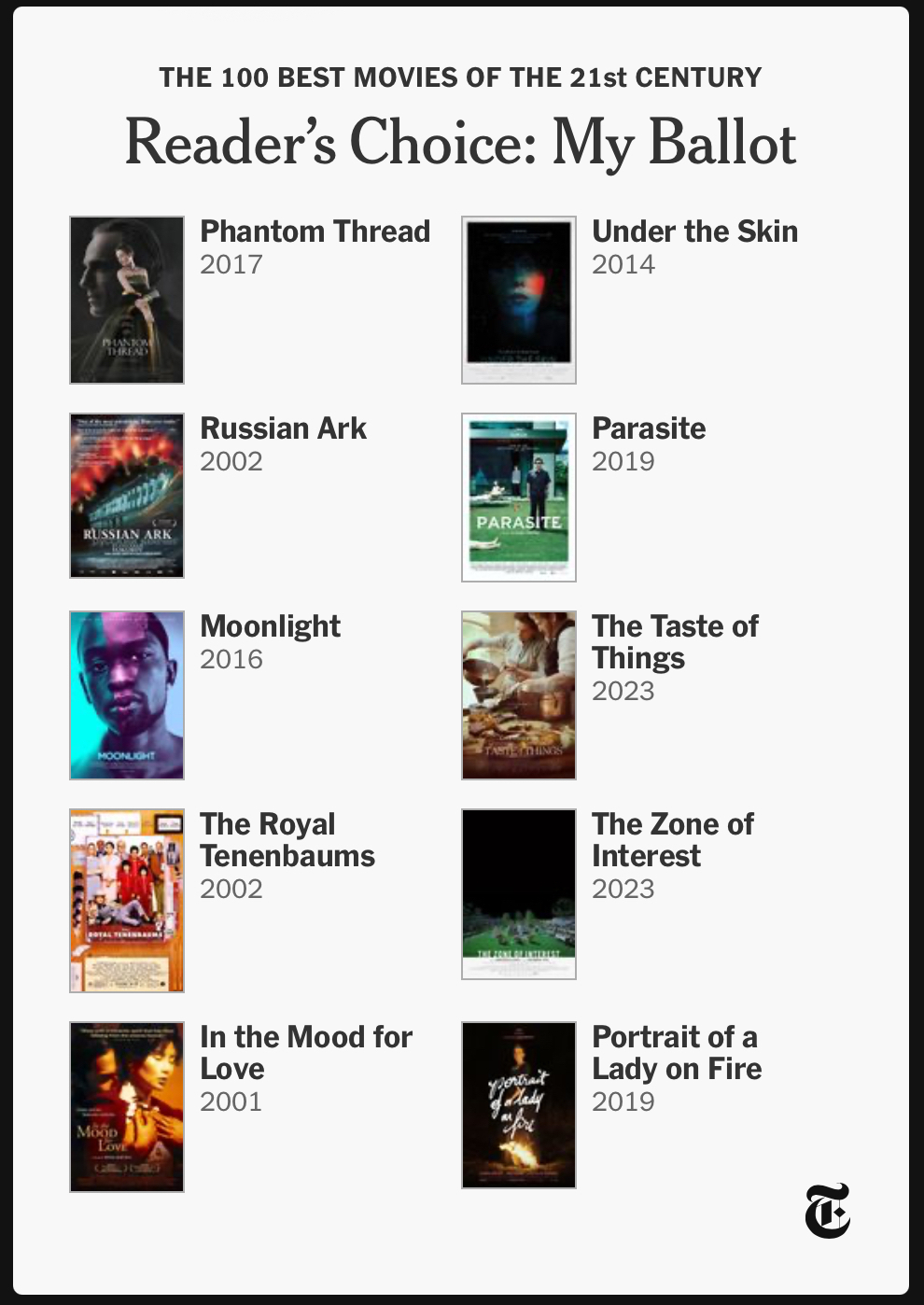
A few more I have great memories of seeing since 2000: Yi Yi, Columbus, Ida, Cold War, There Will Be Blood, Winter’s Bone, The Grand Budapest Hotel, Boyhood, The Lives of Others, The Master, Private Life, Past Lives, Marriage Story, A Separation, Drive My Car, Tree of Life, Tár, Anatomy of a Fall, Manchester by the Sea, Lady Bird, First Cow, The Squid and the Whale, The New World, Saint Omer, Petite Maman, Aftersun, George Washington, Selma, Get Out, The Best of Youth, Bright Star, Meek’s Cutoff, Ex Machina, and Gerhard Richter Painting.
“Revisiting ‘Columbus,’ a Thrilling Drama of Growing Up Modernist”: Lovely appreciation from Richard Brody. Have seen it twice. Planning for a third. (Here’s the trailer.)
Kyle Chayka’s smart close in a smart piece for The New Yorker, “Sam Altman and Jony Ive Will Force A.I. Into Your Life”:
Altman and Ive are positioning their device as a solution to screen fatigue. They promise that their gadget will free us from technology, as evinced by their softly smiling faces in their joint portrait and the warmth and companionship of the café in which they conducted their video interview. But we will only get to this appealingly humane place, they imply, by adopting more technology—their technology. Speculative mockups online imagine an A.I. companion device that looks simple, like a rounded metal amulet—it would be Ive’s style to make the design approachable yet austere. Yet the sleek and frictionless object will rely on a vast infrastructure of factories and server farms; the labor of human maintenance workers and moderators; and, ultimately, the corpus of information that has been digested as training data, which is effectively the entire history of human thought. The little pendants around our necks will be a hundred million Trojan horses, smuggling A.I. into every aspect of our lives. The comforting tone of Altman and Ive’s pitch belies the enormous uncertainty of what their plan would unleash. A recent study in the United Kingdom found that forty-six per cent of youth ages sixteen to twenty-one would prefer to live in a world in which the internet doesn’t exist. Given all the regret and dread that digital culture has prompted, some two decades since the advent of social media, it seems worth thinking twice before allowing Altman and Ive’s incipient creation to occupy our time and our minds, too.
Strategy at the Getty: Not Just Our Art, but All Art
Saturday, May 17, 2025
Love this passage from Richard Rumelt‘s “Good Strategy, Bad Strategy.”
In 1983, Harold Williams — who had once been dean of the UCLA management school — became chairman of the $1.4B Getty Trust. Rumelt explains that Williams grew the Getty “from a small elite collection to a major force in the art world.” The two spoke in 2000, three years after Williams retired. Williams explained his strategy this way:
The Getty Trust was a very large amount of money, and we had to spend a considerable amount each year. Our mandate was art, but I had to decide how to actually spend the funds. We could have simply built a great collection—that would have been the obvious thing to do. Buy art. But I wasn’t comfortable with that as a direction. All we would really accomplish would be to drive up the price of art and move some of it from New York and Paris to Los Angeles.
It took some time, but I began to develop the idea that art could be, indeed, should be, a more serious subject than it was. Art is not just pretty objects; it is a vital part of human activity. In a university, people spend a great deal of effort studying languages and histories. We know all about marriage contracts in remote tribes and the histories of many peoples. But art has been treated as a sideshow. I decided that the Getty could change this. Instead of spending our income on buying art, we could transform the subject. The Getty would begin to build a complete digital catalog of all art, including dance, song, and textiles. It would develop programs to educate art teachers and host advanced research on art and society. The Getty would host the best conversation talent in the world and develop new methods of conserving and restoration. In this way, I decided, we would have an impact far beyond simply putting art on display.
Rumelt provides this coda:
With $65 million to spend each year, Williams could have simply bought art or given money to schools and universities for their arts programs. But by aiming to transform the study of art, Williams designed an objective that was novel and nicely scaled to the resources at his disposal. Put simply, he invested where his resources would make a large and more visible difference. This is the power of concentration—of choosing an objective that can be decisively affected by the resources at hand. There is no way to know whether Williams’s strategy created greater good than a simpler strategy of giving away more money, but it did make a bigger bang and, thereby, attracted more energy and support from employees and outside organizations.
At long last, I tackled and finished George Eliot’s “Middlemarch," switching between audio and paperback over the past several months. What a canvas. Such intelligence. And the prose. The 750 pages are rich with memorable phrases that get inside her characters — one’s “self-cherishing anxiety”; another’s “motiveless levity”; the “reciprocal tolerance” that two have for each other — and whole paragraphs, like this novel-closing gem, that are indestructible, rhythmic, and wise:
Her finely touched spirit had still its fine issues, though they were not widely visible. Her full nature, like that river of which Cyrus broke the strength, spent itself in channels which had no great name on the earth. But the effect of her being on those around her was incalculably diffusive: for the growing good of the world is partly dependent on unhistoric acts; and that things are not so ill with you and me as they might have been is half owing to the number who lived faithfully a hidden life, and rest in unvisited tombs.
“Adolescence,” was a remarkable, unforgettable series, made with emotional and cinematic deftness. Streaming on Netflix.
Sharp, dispiriting NYT piece by Steven Kurutz: “The Gen X Career Meltdown,” subtitled, “Just when they should be at their peak, experienced workers in creative fields find that their skills are all but obsolete.“ I remember being struck by Douglas Coupland’s novel, including the form, when my grad school class dug into it in the late 90s. In his intro, Kurutz reminds us that Coupland’s characters had reconciled themselves to “diminishing expectations of material wealth.”
Case study: How to name and introduce a $3,600 keyboard in words, pictures, and video. (Via Andrew Wilkinson)
“A book always feels like a place I’ve been to”
Saturday, March 22, 2025
From Elisa Gabbert‘s book of essays “Any Person Is the Only Self,” which became a spring break find thanks to the local Venice, Fla., library:
If I remember anything about a book, I also remember where I read it—what room, what chair. I read most of Rilke’s poetry while sitting by a north-facing window in our apartment in Denver, early mornings in 2020 when I woke before dawn and couldn’t get back to sleep.…
A few poems I read in the sun, on our friend’s back porch. She and her husband and kids had fled north to be with family who could help out with the childcare while they worked. Every few days, John and I would drive to their houses and sit on the porch, late summer afternoons and evenings, and share a bottle of white wine while reading, a pencil on the table between us so we could underline and asterisk our books. I didn’t used to like pencils, or writing in books, but John does, and now I do too. I like to dog-ear favorite poems in a book of poetry, a cheat code for the future, so when I pull out a book that I haven’t touched in years, it tells me where to go. Whole experience of a book, any book, is spatial. For years sometimes, I remember which side, verso or recto, my favorite parts appeared on, how deep in the book, how far down the page. A book always feels like a place I’ve been to.
Nodded along to this, feeling a kindred spirit. Gabbert even keeps annual lists recapping the books she’s read that year.
Excellent, visually interesting video review of William Gaddis’s “The Recognitions,” an all-time fav. Eager to reread it in the coming years.
Deeply reported NYT article by Lydia DePillis about St. Louis’s efforts to attract foreign-born residents, historically and within the current climate. A concerning, frustrating read, though it’s heartening to see a range of local leaders advocating for this issue nationally. Attracting, welcoming, and assisting immigrants and refugees has been such an important part of our city’s last few decades, and we’ll be worse off, as a whole region, without it continuing. (I’ve experienced this first-hand; the International Institute helped settle my wife’s family when they arrived more than 25 years ago.) Gilberto Pinela, who I was fortunate to get to know when he was at Cortex, sums up what this could mean for the region:
“We are experiencing the early stages of a winter demographic. It’s not only affecting the city and the region, but soon it will affect the entire state,” said Mr. Pinela, sitting in the mayor’s office at City Hall, in a part of downtown that feels deserted on a weekday afternoon. “The same politicians that are trying to isolate the state are going to be suffering the consequences of this later on.”
Enjoyed John Warner’s new book, “More Than Words: How to Think About Writing in the AI.” A writer and teacher (and a former McSweeney’s editor), Warner has beliefs and ideals, but he’s not a scold, or an alarmist. With good humor and a clear-eyed sense of the positive uses of technology, he describes how ChatGPT — which he calls “automated text,” not “artificial intelligence” — encourages the circumvention of the nourishing, difficult work of both writing and reading. And what ChatGPT’s doing is not writing, he points out; it’s syntax. And he’s here in these pages to celebrate what’s lasting and human about real writing.
“What I want to say about writing is that it is a fully embodied experience. When we do it, we are thinking and feeling. We are bringing our unique intelligences to the table and attempting to demonstrate them to the world, even when our intelligences don’t seem too intelligent.
ChatGPT is the opposite, a literal averaging of intelligences, a featureless landscape of pattern-derived text.
Why have we declared this a marvel when there’s an infinite supply of greater marvels all around us?”
Interesting list in Variety: “The 100 Greatest TV Performances of the 21st Century”. Key rule: One role/actor per show.
From an appropriately nice-sized Smithsonian feature on Robert Caro:
At Princeton, Caro wrote his senior thesis on Hemingway. It was so long—235 pages—that after Caro submitted it, the school capped the size of future submissions at 25,000 words. It was informally known as “the Caro rule.”
Picked the right two weeks to start reading, and be enchanted by, “Middlemarch.” 📚
Just finished Assembly by Natasha Brown. A sharp, slim, piercing novel narrated by a young Black British woman, working in finance, preparing to attend a garden party at her boyfriend’s family estate. Here’s an evening work scene, from the opening:
After the Digestif, He Gets Going
She understood the anger of a man who himself understood in his flesh and bones and blood and skin that he was meant to be at the head of a great, hulking giant upon whom the sun never set. Because it was night, now, and he was drunk. He felt very small, perhaps only a mouth. A lip or a tooth or a rough, inflamed bud on a dry white tongue slick with phlegm at the back, near the throat. The throat of a man with a sagging gut and thinning hair cropped so short. So , when that mouth opened up and coughed its vitriol at her, making some at the table a little uncomfortable, she understood the source of its anger, despite being the target. She waited for the buzz of her phone to excuse her and — in the meantime — quietly, politely, she understood him.
Orlando Whitfield: The Feel of Wealth
Thursday, January 16, 2025
From the author’s terrific memoir “All That Glitters: A Story of Friendship, Fraud, and Fine Art”:
There is a rootlessness to the very wealthy in the twenty-first century, a floating ease in both place and time that is mirrored, or perhaps emboldened, by a certain kind of space. Oases devoid of responsibility or obligation allow one an escape from reality that is almost womb-like in its comfort. In the Connaught Bar, if you can bag a table (it was named ‘Best Bar in the World’ by a panel of so-called experts in 2020, the year in which, as I recall it, everyone had to stay home in order to get a load on), you will be surrounded by an international array of players united by one thing only: money.
As you walk in you will be greeted by a server in a school-uniform grey dress, black-patent-leather-belted primly at the waist. You’ll note the way piped music seeps into the room like an odorless gas, and the way the lighting, which manages somehow to maintain a crime scene luster whatever the weather outside, pools between the tables and chairs and glances off the glass table tops and brass fittings and the painted silver paneling. Think air travel in the 1960s with a touch of netherworld glamour. You’ve seen it in a movie. Have you got a reservation? We’re rather full tonight.
The guests are ensconced in cashmere and softly shrugging leather; crisp, dark denim in stark juxtaposition to the falsetto glint of diamonds and the low-energy glow of rose gold. Their torpor is somehow moribund, Bourne of the ennui that will always affect those for whom any kind of satisfaction is gratuitously imminent. The room shimmers non-Don status – the financial equivalent of diplomatic immunity — and they talk of elsewhere, always elsewhere, as if the present moment were fraught with some kind of difficulty.
Another superb Atlantic piece: “Walk on Air Against Your Better Judgment," in which Caitlin Flanagan writes beautifully about her own family’s connections to Seamus Heaney. Still grateful for the college semester I spent in the early 90s exploring Heaney’s striking poetry.
Year in Review: 2024
Friday, December 27, 2024
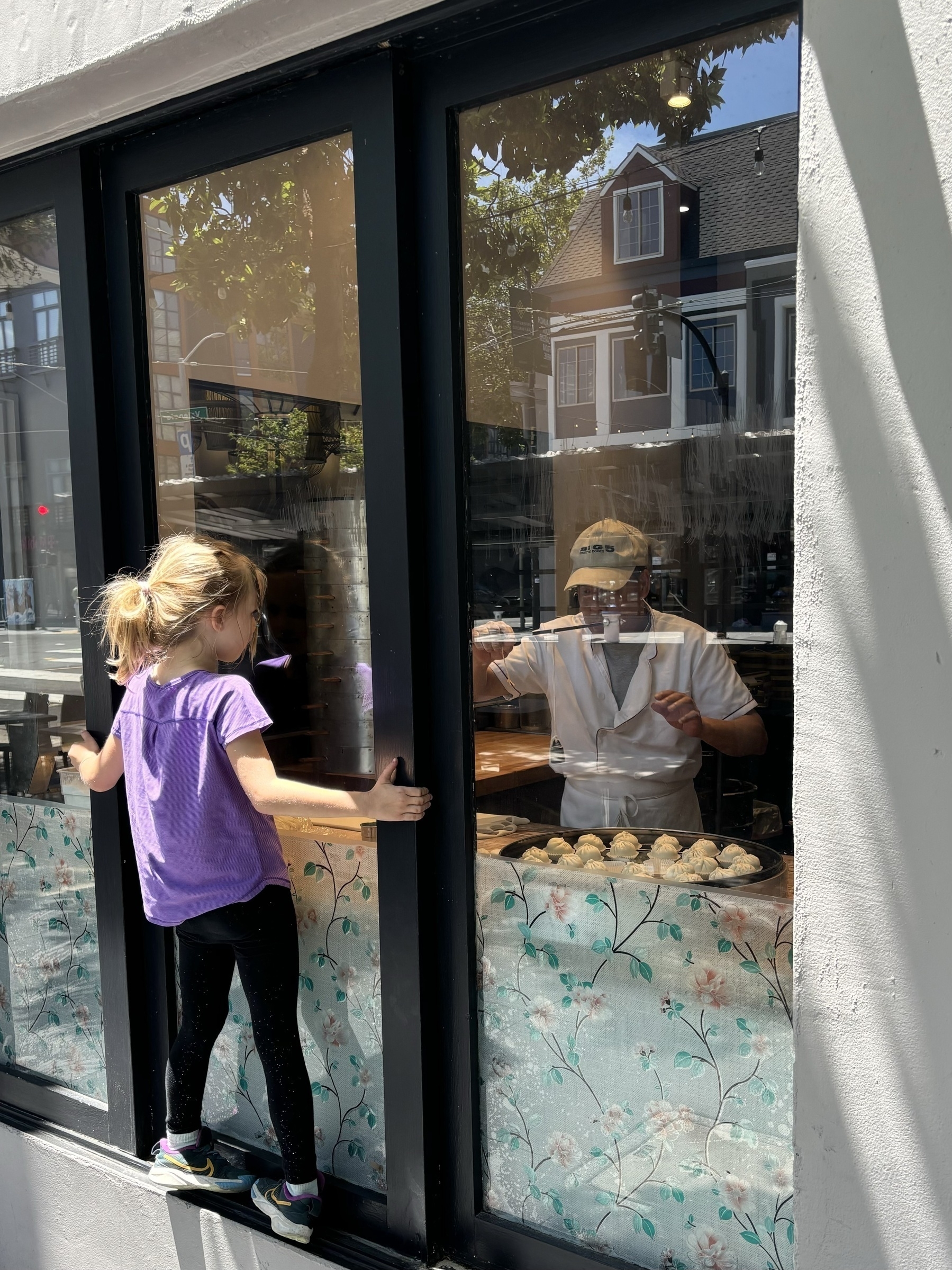
As I’ve done for the past few decades, I’m ending the year with a look back at some cultural highlights I found most fulfilling during the past 12 months:
-
Hitting the road with the kids: 2024 was a special year for family travel — an early summer trip to stay with relatives in San Francisco (a moment from there above), then a late summer stay with my sister just outside of D.C. Muir Woods, Presidio Tunnel Tops, the de Young, the Glenstone, MLK Memorial, National Gallery, and so much more. Great ages for the kids to experience both. Fortunate to have been able to do it.
-
Nonfiction books: “The Country of the Blind: A Memoir at the End of Sight," by Andrew Leland; “The Vanity Fair Diaries: 1983 – 1992” by Tina Brown; “All Things Are Too Small: Essays in Praise of Excess” by Becca Rothfeld; “The Dawn of Everything: A New History of Humanity” by David Graeber and David Wengrow; “The Message” by Ta-Nehisi Coates; “Kafka: Diaries” (translated by Ross Benjamin); “To Fall in Love, Drink This” by Alice Ferring; “Lovely One: A Memoir” by Ketanji Brown Jackson; and “The Contagion Next Time” by Sandro Galea.
-
Chunky, visual-heavy nonfiction books: “The Look of the Book: Jackets, Covers, and Art at the Edges of Literature” by Peter Mendelsund and David J. Alworth; “The Work of Art: How Something Comes from Nothing” by Adam Moss (an exceptional editorial mind); “I. M. Pei: Life Is Architecture” by Shirley Surya; “The Wes Anderson Collection” by Matt Zoller Seitz; “Branding: In Five and a Half Steps” by Michael Johnson; “How Design Makes Us Think and Feel and Do Things” by Sean Adams; and “Crossing the Line: Arthur Ashe at the 1968 US Open” (multiple editors/writers).
-
Novels: “The Fraud” by Zadie Smith; “Nonfiction: A Novel” by Julie Myerson; “Intermezzo” by Sally Rooney; and “Catalina” by Karla Cornejo Villavicencio.
-
Books of poems: “Scattered Snows, to the North” by Carl Phillips and “A Film in Which I Play Everyone” by Mary Jo Bang, both STL-connected writers.
-
Books about what went wrong at Twitter: I should not have spent time reading two books on this subject, but they were interesting: “Battle for the Bird” by Kurt Wagner and “Character Limit: How Elon Musk Destroyed Twitter” by Kate Conger and Ryan Mac.
-
Rereading “Gilead”: Endures. Recommended for when you’ve just read two books about Twitter.
-
The William Gass Centenary: I spent many years writing about and promoting awareness and discussion of Bill’s work, and I had the great fortune of getting to know both Bill and Mary during the last decade of his long and productive life. In October, WashU organized a day-long event to mark what would have been Bill’s 100th birthday. While the Gass projects I launched over the years are set on a kind of permanent simmer, it was meaningful to re-immerse myself in the world of Bill’s writing. Videos and resources are available on the university’s centenary website.
-
Movies: I was deeply impressed and moved by “The Zone of Interest”; “The Taste of Things”; “Past Lives”; “Anatomy of a Fall”; “Petite Maman”; “Saint Omer”; “Aftersun”; and “His Three Daughters.” Also enjoyed “Killers of the Flower Moon”; “American Fiction”; “You Hurt My Feelings”; “Between the Temples”; “May December”; “Barbie”; “Oppenheimer”; “Maestro”; “Janet Planet”; “She Said”; “Showing Up”; “BlackBerry”; and “Dumb Money.” Temporarily engrossing: “Conclave.” Interesting docs: “Modernism, Inc.: The Eliot Noyes Design Story”; “Martha.”
-
Satisfying rewatches: “Marriage Story”; “Heat”; and “Kicking and Screaming” (prompted by The Rewatchables). Plus, with the kids, “Spellbound” and “The Princess Bride.”
-
Articles about the world: “Seventy Miles in the Darién Gap” by Caitlin Dickerson, The Atlantic; “Our Strange New Way of Witnessing Natural Disasters," by Brooke Jarvis, NYT Magazine; “The Forgotten History of Hitler’s Establishment Enablers,” by Adam Gopnik, The New Yorker; and “Unsafe Passage: A Palestinian Poet’s Perilious Journey Out of Gaza,” by Mosab Abu Toha, The New Yorker.
-
Articles about America: “What Will Become of American Civilization?" by George Packer, The Atlantic; “The Golden Age of American Jews Is Ending,” by Franklin Foer, The Atlantic; “The Man Who Died for the Liberal Arts," by David M. Shribman, The Atlantic; and “Shibboleth” by Zadie Smith, The New Yorker.
-
Personal essays: “On Cancer and Desire," by Annie Ernaux, The New Yorker; “The Birth of My Daughter, the Death of My Marriage” by Leslie Jamison, The New Yorker; “If My Dying Daughter Could Face Her Mortality, Why Couldn’t the Rest of Us?" by Sarah Wildman, NYT; and “Variations on the Theme of Silence," by my friend Jeannette Cooperman, The Common Reader.
-
Great match of medium and story: “She Slept With a Violin on Her Pillow. Her Dreams Came True in Italy," by Valeriya Safronova, with photographs and video by Sasha Arutyunova, NYT; “How Taylor Tomlinson Nailed Her Closing Joke," by Jason Zinoman, NYT.
-
TV shows: The show that made me smile the most all year was “Girls5Eva” (all seasons are streaming on Netflix). Huge fan as well of “Beef”; “The Bear” seasons 1 and 2; “Ripley”; “My Brilliant Friend” season 1; and “Fargo” season 5. Enjoyed “Magpie Murders” and “Bad Monkey.”
-
New Music: “Oh Smokey” from Clem Snide; “Manning Fireworks” from MJ Lenderman; “Charm” from Clairo; “Patterns in Repeat” from Laura Marling; “Hit Me Hard and Soft” from Billie Eilish; and “Chromakopia” from Tyler, The Creator. Doechii’s Tiny Desk performance was fierce.
-
New podcasts: My favorite new-to-me podcast this year was Talk Easy with Sam Fragoso. The host is wise beyond is years, does superb research and prep, and seems to quietly relish his good fortune of gently steering weighty conversations. (You can’t go wrong choosing an episode, but Fragoso’s conversation with Ocean Vuong was especially memorable, particularly for the author’s insights about youth and masculinity in America.) Another new discovery I enjoyed, as a former magazine EIC, was Print is Dead (Long Live Print). I can’t remember if I discovered it last year or this year, but I enjoy Jarrett Fuller’s Scratching the Surface podcast (as well as his blog).
-
A few podcast episodes: Bonnie Prince Billy talks through “I See a Darkness” on Life of a Record; The Wolf of Wine decodes his single “Quintin Tarantino”; Zadie Smith talks through “The Fraud” on Fresh Air; and the Dissect hip-hop aficionados talk through the Best Bars of 2024.
-
Connecting with two living artists: Any year when my wife Tamara presents a new exhibition is a good one, and this year saw her open “Delcy Morelos: Interwoven," at the Pulitzer Arts Foundation. Having our kids meet the Colombian artist, and hearing her talk astutely about her work, were highlights from the year. Grateful as well to meet Julie Blackmon, one of my favorite living photographers, and hear her discuss her distinctive Midwestern work at the Saint Louis Art Museum.
-
Home tour with Laura Dewe Mathews: I have such admiration for Matt Gibberd and what he’s built with The Modern House — from the real estate listing website to the Homing In podcast to the publications, each one presented handsomely and with soul. In the summer, Matt shared a video interview and tour he did with architect Laura Dewe Mathews. I was thinking back to this one in particular, because Mathews' lovely home is known locally as “the gingerbread house” — and our kids are asking to begin nibbling away at theirs.
With that, sending best wishes to you in the new year.